


Exploring new perspectives on architecture based on continuity and topology.

Architecture can be viewed not merely as a physical "thing," but as a "continuous space" where boundaries blend together, surfaces transform, and space flows without interruption. This perspective transcends conventional architectural concepts and invites us into the world of mathematical architecture, incorporating mathematical structures and topology. This time, we will introduce a new perspective on architecture centered on continuity and topology, along with specific methods and examples.
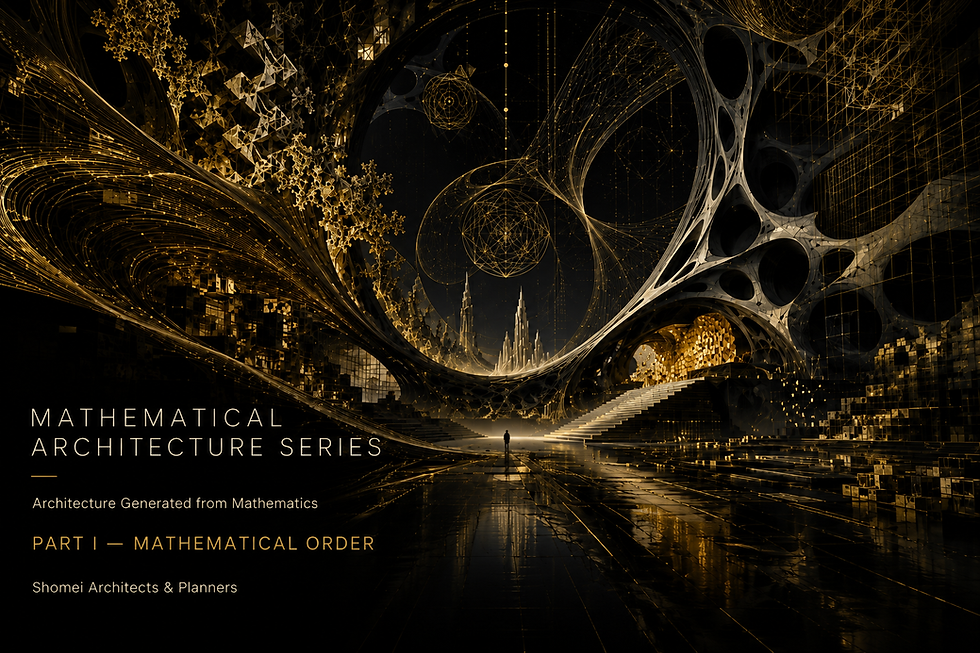
Methods for incorporating continuity into architecture
Continuity refers to the property of spaces and forms to be continuously connected without interruption. In architecture, the goal is to create spaces that are not clearly defined by boundaries such as walls, floors, and ceilings, but rather spaces that smoothly transform and flow continuously.
1. Topological spatial design
Topology is a branch of mathematics that studies the deformation and connectivity of shapes. When applied to architecture, it enables designs that maintain continuity and connection while flexibly changing the boundaries and shapes of space. For example, buildings with a continuous surface, such as a donut-shaped space or a Mobius belt, are prime examples of topological thinking.
2. Utilizing Generative Design
Generative design is a method that automatically generates forms based on algorithms and rules. This allows for the efficient creation of architectural designs with complex continuities and topological structures. When combined with parametric design tools, designers can explore optimal spaces by experimenting with a variety of deformation patterns.
3. Applications of Fractal Structures
Fractals are complex forms that exhibit self-similarity and are frequently found in nature. Incorporating fractal structures into architecture allows for continuous yet multi-layered spatial representation. For example, hierarchically repeating patterns emphasize spatial continuity and provide a rich visual experience.
Specific examples and tool introductions
Cinematic architectural installation
Installations that create visually continuous spaces, like those in a film, help us experientially understand the concept of continuity. These works are designed to blur the boundaries of space, allowing viewers to feel the flow of space.
Midjourney and the use of AI art
Recently, there has been a growing trend to use AI art tools like Midjourney to generate images of continuity and topological spaces. These tools help visualize architectural concepts and generate new ideas in the early stages of design.
Parametric design software
Parametric design software such as Grasshopper and Dynamo allows you to manipulate architectural forms using mathematical functions and rules. This makes it easy to adjust and optimize complex shapes with continuity.
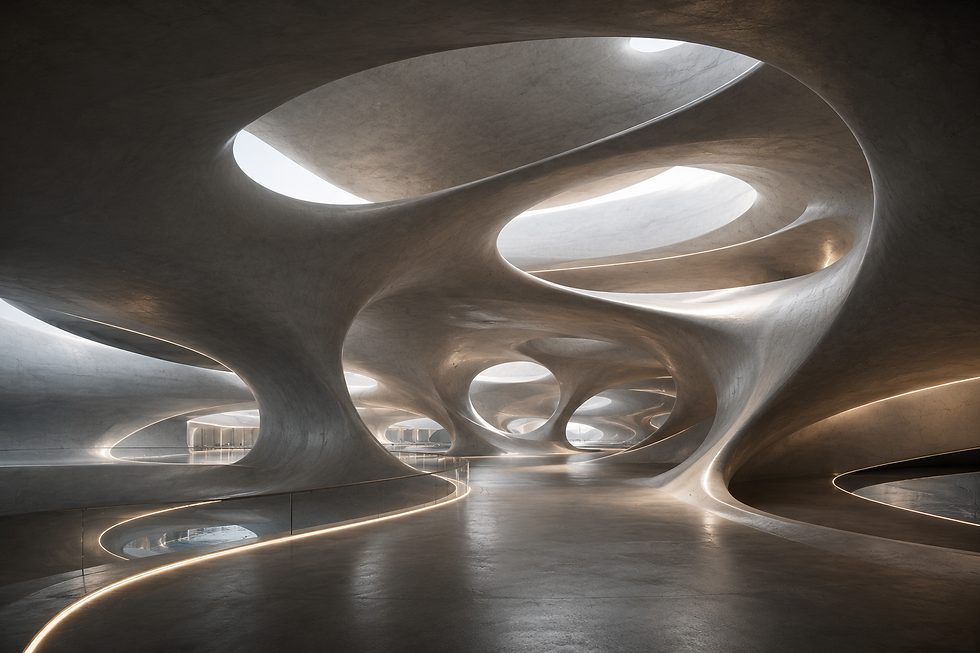
Learning resources for understanding continuity and topology
Its role as a concept book
To deepen your understanding of this field, books and ebooks that serve as concept books are helpful. In particular, series on mathematical architecture are valuable resources that allow you to learn from both theoretical and practical perspectives.
Exploring the relationship between mathematics and architecture
Applying mathematical concepts to architecture requires a foundation of knowledge in topology, fractals, symmetry, and recursion. These topics can be learned through university lectures or online courses and then applied to actual design work.
Practical workshops and seminars
Workshops focusing on continuity and topology are being held for architectural researchers and students. Participating in these workshops allows you to experience the latest tools and methods and expand your network.

Architecture that incorporates continuity and topology opens up new possibilities for space. Mathematical architecture , based on mathematical structures, offers users new experiences not only through the beauty of form but also through the continuous flow and transformation of space. It is essential to actively incorporate and practice these concepts in future architectural research and design.


Comments