


The future pioneered by modern Japanese architects

The Japanese architectural world possesses a unique culture where tradition and innovation merge. In particular, in the field of modern architecture, architects who incorporate mathematical concepts into spatial design, creating buildings with a sense of weightlessness that transcends gravity, are attracting attention. They translate abstract theories such as chaos theory, topology, and higher-dimensional geometry into visual and spatial forms, opening up new possibilities for architecture unlike anything seen before.
Innovative spaces envisioned by modern Japanese architects
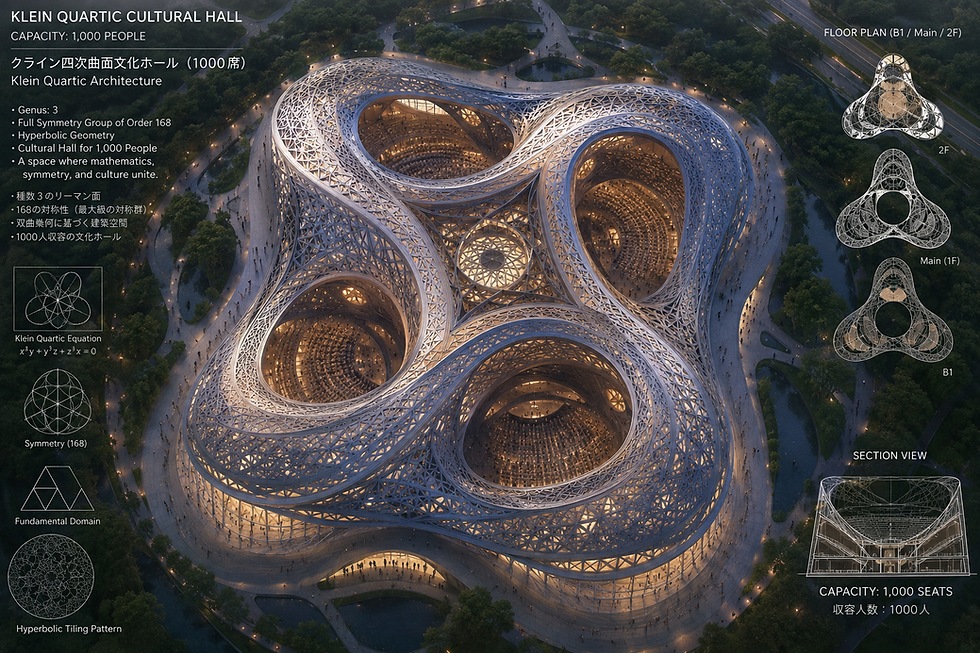
Modern Japanese architects are not merely designing buildings, but redefining the very concept of space. For example, they are transcending the physical constraints of architecture, such as "weight" and "stability," to create designs that appear to float in mid-air. This is made possible by applying mathematical theories and fusing structural mechanics with aesthetics.
Specifically, this involves using topology to design continuous and deformable spaces, and applying chaos theory to create unpredictable forms. This provides visitors with fresh experiences and expands the possibilities of architecture.

This type of architecture is found in a wide range of buildings, from private residences to public facilities and corporate offices, bringing innovation to how space is used and how people move around. In particular, designs that take into account the incorporation of natural light and airflow pursue a futuristic beauty while harmonizing with the environment.
Characteristics and influence of Japanese modern architects
Modern Japanese architects are characterized by their respect for the aesthetics of traditional Japanese architecture while integrating contemporary technology and mathematical theory. Their works are not merely buildings, but are appreciated as "living spaces" that combine mathematical beauty and functionality.
Mathematical approach
By applying abstract mathematical theories to architecture, complex shapes and structures can be realized.
Designs that defy gravity
By incorporating a sense of weightlessness and asymmetry, the design reinvents conventional architectural concepts.
Harmony with the environment
We promote sustainable design by calculating natural light and airflow.
These characteristics have had a significant impact on the architectural world both domestically and internationally. In particular, among modern Japanese architects, those specializing in mathematical architecture have attracted global attention, and their works frequently win international architectural awards.

Who are the three greatest masters of modern architecture?
There are three great masters who are indispensable when discussing modern Japanese architecture. Each of them brought innovation to the Japanese architectural world with their unique perspective and techniques.
Kenzo Tange
A leading figure in post-war Japanese architecture, he is known for his innovative structures and designs, such as the National Yoyogi Stadium.
Tadao Ando
Many of his works pursue the aesthetics of exposed concrete and incorporate unique techniques for utilizing natural light.
Kazuyo Sejima
It has gained worldwide acclaim for its light, ethereal designs and use of transparent materials.
Although these architects rarely directly employed mathematical theories, they had a significant influence on contemporary modern architects in their innovations in spatial concepts and structures.
The future and possibilities of mathematical architecture
Mathematical architecture is a field that will attract increasing attention in the future. By applying chaos theory and topology, new spaces are being created that go beyond the conventional framework of architectural design. As a result, architecture is evolving not merely as a "building," but as a dynamic and constantly changing "living space."
Applications of Higher-Dimensional Geometry
By incorporating spatial concepts beyond three dimensions, complex shapes and structures can be realized.
A design that defies gravity
We pursue a sense of weightlessness and asymmetry to provide visual surprises.
Environmentally adaptive architecture
Designed to harmonize with the natural environment and support a sustainable society.
These technologies can be applied not only to private homes and commercial facilities, but also to public spaces and urban planning. The future of architecture will offer more freedom and creativity through the fusion of mathematical theory and technology.
Practical advice: How to incorporate innovative architectural design
To achieve innovative architectural design, it is important to keep the following points in mind.
Understanding mathematical theory
Learn the fundamental concepts of chaos theory and topology, and apply them to design.
Utilization of the latest technology
We utilize 3D modeling and simulation software to accurately design complex shapes.
Emphasis on harmony with the environment
We strive for sustainable design by taking natural light and airflow into account.
Collaboration with experts
We work closely with structural engineers and environmental designers to pursue feasible designs.
By following these steps, you can create innovative and beautiful architectural spaces. In particular, incorporating the expertise of specialists such as modern architects from Japan will be a shortcut to success.
Japanese modern architects shaping the future
Modern Japanese architects continue to explore the possibilities of mathematical architecture. Their works transcend mere buildings, creating new value in space. The sense of weightlessness and the complex, beautiful geometric forms surprise and inspire visitors.
The future of architecture will continue to offer more free and creative spaces through the fusion of mathematical theory and technology. For individuals and organizations seeking innovative architectural design, the approaches of modern Japanese architects offer valuable insights.

Future architecture will not be merely physical structures, but "living spaces" that combine mathematical aesthetics and functionality, enriching our lives and work.


Comments