


Lorenz Attractor Architecture

What is Lorenz Attractor Architecture?
How Chaos Theory Is Reshaping the Future of Spatial Design
Architecture has always borrowed from nature — from the golden ratio of the Parthenon to the organic curves of Zaha Hadid. But what happens when architecture borrows not from nature's forms, but from nature's behavior?
Lorenz Attractor Architecture is a design methodology that derives spatial structure directly from chaos theory — specifically from the mathematical system known as the Lorenz attractor. The result is not a building that looks chaotic. It is a building that is generated by chaos, in the same way that weather patterns, turbulent rivers, and neural activity are generated by underlying mathematical laws.
This is not speculative design. This is architecture as a mathematical reality.
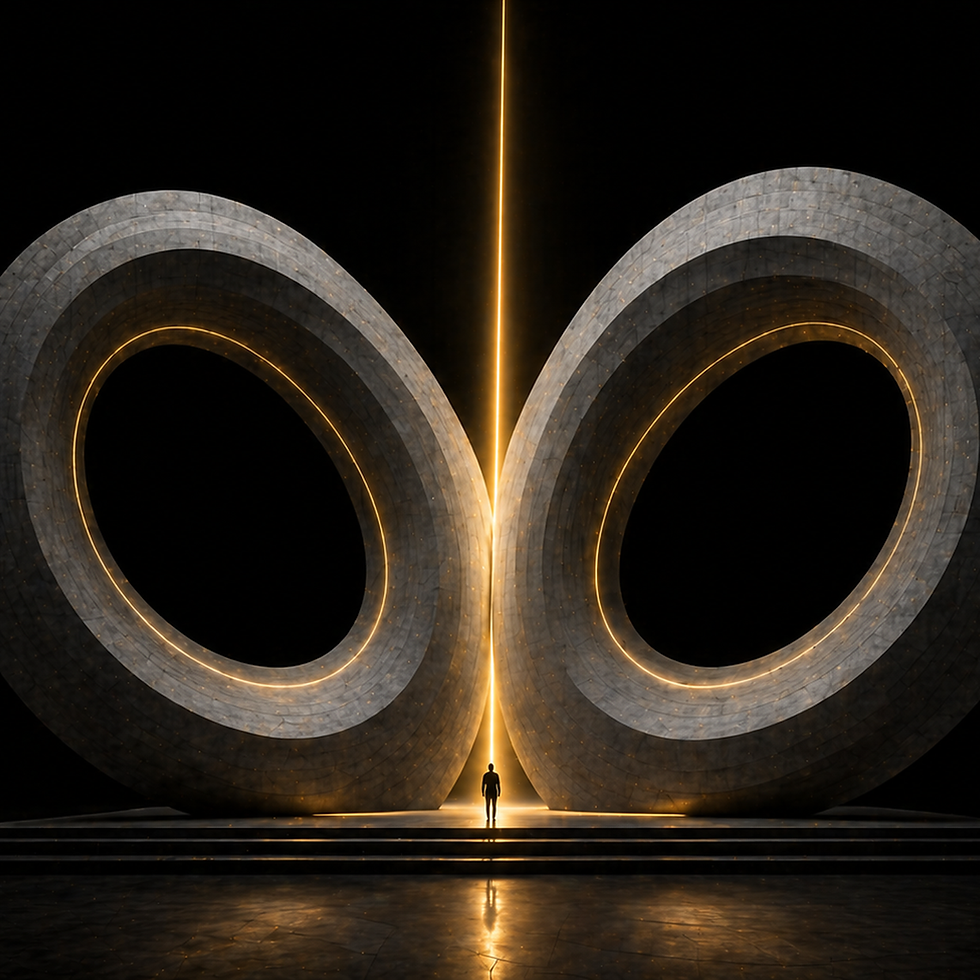
What Is the Lorenz Attractor?
In 1963, meteorologist Edward Lorenz discovered that a simple set of three differential equations could produce behavior of extraordinary complexity. The equations describe the movement of a point in three-dimensional space:
dx/dt = σ(y − x)
dy/dt = x(ρ − z) − y
dz/dt = xy − βz
With standard parameters (σ = 10, ρ = 28, β = 8/3), the system never repeats itself, never settles, and never escapes — tracing an infinite, butterfly-shaped trajectory through space.
This is the Lorenz attractor: a structure of permanent motion, dynamic stability, and infinite non-repetition.
What makes it architecturally significant is not its visual form alone. It is the logic behind the form — a logic of flow, of continuous circulation, of spaces that lead into other spaces without end.
From Equation to Architecture: The Design Process
Translating a mathematical system into inhabitable space requires a clear methodology. The process used in this series follows four stages:
Stage 1 — Attractor Geometry
The Lorenz equations are computed numerically, generating a three-dimensional trajectory. This trajectory forms the primary organizational logic of the building — its skeleton, its DNA.
Stage 2 — Structural System
The attractor curve is translated into a structural lattice. Flow lines become beams. Density fields become walls. The mathematical behavior of the system directly informs the structural logic.
Stage 3 — Spatial Organization
Spatial volumes are carved from the structural lattice. The double-loop geometry of the attractor naturally creates two distinct zones — upper loop and lower loop — connected by a central transition space. These become the functional areas of the building: exhibition levels, observation decks, atrium voids.
Stage 4 — Architectural Form
The system is materialized. Concrete surfaces follow the curvature of the attractor. Gold light traces the primary circulation paths. The building does not express chaos — it embodies the mathematical logic that generates chaos.
Key Spatial Qualities
Buildings derived from the Lorenz attractor share several distinctive spatial characteristics:
Continuous Circulation There are no dead ends. Movement through the building follows the logic of the attractor — always flowing, always connecting, never terminating. Visitors experience space as a field of continuous motion rather than a sequence of rooms.
Double-Loop Structure The butterfly form of the attractor naturally produces a bilateral spatial organization. Two large loops — east and west — are connected at a central node. This creates an inherent spatial duality: symmetry without repetition, balance without rigidity.
Nonlinear Vertical Flow Unlike conventional buildings where floors are stacked horizontally, Lorenz Attractor Architecture treats vertical movement as a continuous spiral. The section diagram reveals levels that flow into each other — Level 1 through Level 7, Basement 1 and 2 — not as discrete floors but as moments in a continuous spatial journey.
The Central Void At the intersection of the two loops, a vertical void cuts through the entire height of the building. This void — illuminated by a single column of gold light — functions as the building's axis mundi: the point of highest energy density in the mathematical system, made visible as architecture.
Chaos Field: Where Order Becomes Complexity
One of the most architecturally fertile concepts in chaos theory is the transition between order and chaos. In the Lorenz system, small changes in initial conditions produce dramatically different trajectories — the famous "butterfly effect."
In spatial terms, this transition is explored through what we call the Chaos Field: an architectural condition in which rigid geometric order (grid, structure, module) gradually dissolves into continuous nonlinear flow.
The design moves through four phases:
Order — Grid and structural regularity
Disruption — Fragmentation of the grid
Transition — Vector field emergence
Chaos — Continuous flow, self-organized form
This is not a stylistic decision. It is a spatial argument: that the most interesting architecture exists precisely at the boundary between predictability and complexity.
Vortex Structure: Architecture as Gravitational Field
Another application of chaos dynamics in spatial design is the vortex — a structure of spiraling motion that draws everything toward a central point.
In Vortex Architecture, the building plan is derived from a tornado-like attractor. Circulation paths spiral inward and downward, drawing visitors toward a luminous core. The experience is one of controlled descent — not threatening, but profoundly orienting.
The section reveals a conical spatial form: wide at the upper levels, contracting to a focused point of intensity at the base. People are drawn into the core through spiraling circulation and continuous descent.
This spatial typology has clear applications for:
Museum and exhibition spaces
Meditation and contemplative environments
Urban civic monuments
The City as Phase Space
The implications of chaos-based design extend beyond individual buildings to urban scale.
Phase space is a mathematical concept describing all possible states of a dynamic system. When applied to urban design, the city becomes a diagram of competing attractors — zones of stability, zones of transition, and zones of emergent complexity.
Lorenz City is an urban proposal in which the double-loop attractor organizes the entire metropolitan structure. Infrastructure follows paths of dynamic stability. Density emerges from mathematical flow rather than zoning regulations. The city does not grow by plan — it evolves by system.
The result is a "Programmable Environment": a city that adapts, that responds, that behaves according to the same mathematical logic that governs weather, ecosystems, and neural networks.
Why This Matters Now
We are living through a fundamental shift in how form is generated.
For most of architectural history, form was the product of human intuition — shaped by hand, by eye, by cultural convention. In the 20th century, computation allowed forms of extraordinary complexity to be designed, but the logic behind them remained largely intuitive.
Chaos-based architecture represents a different proposition: that form can be discovered rather than designed. That the mathematical systems governing natural phenomena contain spatial intelligence that exceeds human imagination.
The Lorenz attractor has been tracing its infinite path through three-dimensional space for over sixty years. It has been waiting to become architecture.
About This Series
Mathematical Architecture: Chaos Studies Vol.1 is the first volume in a series exploring the architectural implications of mathematical systems. Future volumes will investigate:
Vol.2 — Fractal Geometry: Mandelbrot Architecture
Vol.3 — Minimal Surface Structures: Schwarz Surface Architecture
Vol.4 — Aperiodic Order: Penrose Tiling Architecture
Vol.5 — Symmetry & Lattices: E8 and Leech Lattice Architecture
Each volume follows the same methodology: from mathematical system to spatial structure, from equation to inhabitable form.
Download Vol.1 (free): shomei.gumroad.com/l/apmao Download Vol.2 ($5): shomei.gumroad.com/l/qjxljj

Shomei Architects & Planners Architecture is not designed. It is discovered.


Comments