


Gravity-Transcending Structural Design - Pioneering the Future of Innovative Architecture

In the world of architecture, challenging the natural law of gravity has always been a challenge. Gravity-transcending structural design goes beyond mere technical challenges, representing an innovative approach that translates mathematical theories and abstract concepts into spatial ideas and visual forms. This article explores the world of gravity-defying, floating architectural designs, utilizing elements of mathematical architecture such as chaos theory, topology, and higher-dimensional geometry.
The foundations and significance of gravity-transcending structural design
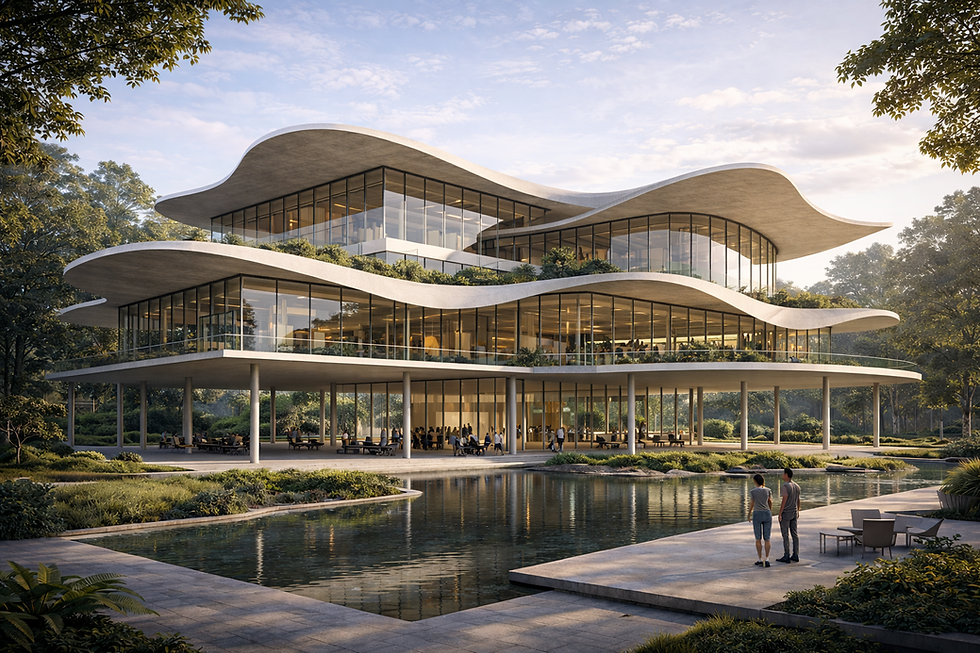
Gravity is one of the most fundamental and important constraints in architectural design. Buildings must support their own weight and withstand external forces. However, gravity-transcending structural design does not simply accept this constraint, but uses mathematical theories to minimize the effects of gravity, creating the illusion that the building is floating in mid-air.
This design method has the following characteristics:
Applications of mathematical theory : Using chaos theory and topology to analyze the distribution of complex forces and the stability of structures.
Utilization of higher-dimensional geometry : By designing forms from a perspective that transcends three-dimensional space, shapes previously unimaginable in conventional architecture are realized.
Visual lightness : Creating a sense of weightlessness and transparency that defies gravity, thereby creating new value in the space.
The fusion of these elements creates a space that is not merely a building, but a work of art.
Practical Examples and Technologies of Gravity-Transcending Structural Design
In actual design, the following technologies and methods are used:
Tensegrity structure
By utilizing the balance between tension and compression, we create structures that are lightweight yet possess high strength. This makes it possible to design buildings in a way that makes it appear as if parts of the building are floating in mid-air.
Applications of Chaos Theory
By using chaos theory to predict force dispersion and oscillations, complex mechanical behavior can be controlled, resulting in stable structures.
Topological design
By incorporating topological concepts such as continuity and the number of holes into the shape design, we create free forms that go beyond conventional linear structures.
A perspective from higher-dimensional geometry
It projects geometric concepts of four dimensions or more into three-dimensional space, providing a new spatial experience through visual projection.
These technologies are not merely theoretical; they are being applied to actual architecture and interior design. For example, designs that alter the sense of gravity in a space, such as staircases that appear to float or furniture that seems to be suspended in mid-air, are attracting attention.
What is the structure of a skyscraper?
Skyscrapers require sophisticated structural design to withstand gravity, wind pressure, earthquakes, and other external forces. The challenge here is not simply to make them taller, but to ensure safety while maintaining a light and beautiful form.
Innovative structural technologies in skyscrapers
Damper system
A device that absorbs wind and earthquake tremors, suppressing building movement. This improves the comfort and safety of residents.
Tube structure
The design enhances structural integrity while maximizing interior space by supporting the entire building with an external frame.
Utilization of composite materials
By using lightweight yet high-strength materials, the building's own weight is reduced.
These technologies are optimized through mathematical analysis and simulation, enabling designs that defy gravity. For example, curved appearances and asymmetrical shapes can be achieved by thoroughly calculating the distribution of forces.

Applications of mathematical architecture in spatial design
Mathematical architecture is an important method not only for increasing structural strength but also for improving the quality of space. In particular, innovation can be seen in the following areas:
Creating visual illusions
Topology and geometric patterns are used to create the illusion of infinite space and a sense of weightlessness.
A fusion of function and beauty
Mathematical shapes achieve both functional strength and aesthetic harmony simultaneously. For example, curved walls can enhance acoustic effects.
Applications to interior design
By incorporating mathematical shapes into furniture and lighting fixtures, the overall sense of unity and uniqueness of the space is emphasized.
These applications are being developed in a wide range of settings, from private homes to public facilities and commercial spaces. By incorporating a mathematical architectural perspective, spaces are transformed from mere places of residence or work into artistic experiences that stimulate the senses.
Gravity-Transcending Structural Design Shaping the Architecture of the Future
Modern architecture is no longer merely about overcoming physical constraints; it's at a stage where it's about creating new value in space. Our practice, through gravity-transcending structural design , maximizes the potential of mathematical architecture, proposing buildings with an unprecedented sense of weightlessness and lightness.
Looking ahead,
Sustainable use of materials
Development and application of lightweight and strong materials while minimizing environmental impact.
Integration with digital technology
Realizing complex shapes using AI and 3D printing.
Pursuit of multidimensional spatial experiences
Integrating with VR and AR technologies, this project fuses physical architecture with digital spaces.
These initiatives have the potential to fundamentally change the future of architecture. Innovative structural design that defies gravity is not merely a technological innovation, but a path to creating a new spatial culture.
The innovative world of mathematical architecture transcends the natural law of gravity, infinitely expanding the possibilities of space. Architecture of the future will continue to evolve into a new dimension where science and art merge.


Comments